
Introduction
Recently I was in Costa Rica (Ref.1) and I used WWV to set my watch for UTC time to accurately read my sextant. We tend to take time for granted now with the Internet & GPS, but time stations like WWV still provide an essential service. WWV (Ref.2) can also be used to study propagation. In previous posts I used the Canadian time Station CHU (Ref.3).
WWV Station Parameters
| Frequency | Power |
| 2.5MHz | 2.5KW |
| 5.0MHz | 10KW |
| 10.0MHz | 10KW |
| 15.0MHz | 10KW |
| 20.0MHz | 2.5KW |
| 25.0MHz (Experimental) | 2.5KW |
| Transmission: AM_DSB , 50% Tones, 100% Secs, 75% Voice | |
| Antenna: 1/2 Wave Vertical Omnidirectional | |
| Latitude = 40.68degN Longitude = 105.04degW |

Figure 1 lists the WWV station parameters and frequencies used. Transmit power is 10KW on all bands, except 2.5/20/25MHz where the power is 2.5KW. Antennas are 1/2 wave verticals, with the 25MHz antenna as a 1/2 wave vertical dipole (Ref.2). Figure 2 shows the path between WWV and my home QTH on Google Earth.
RTL-SDR Reception


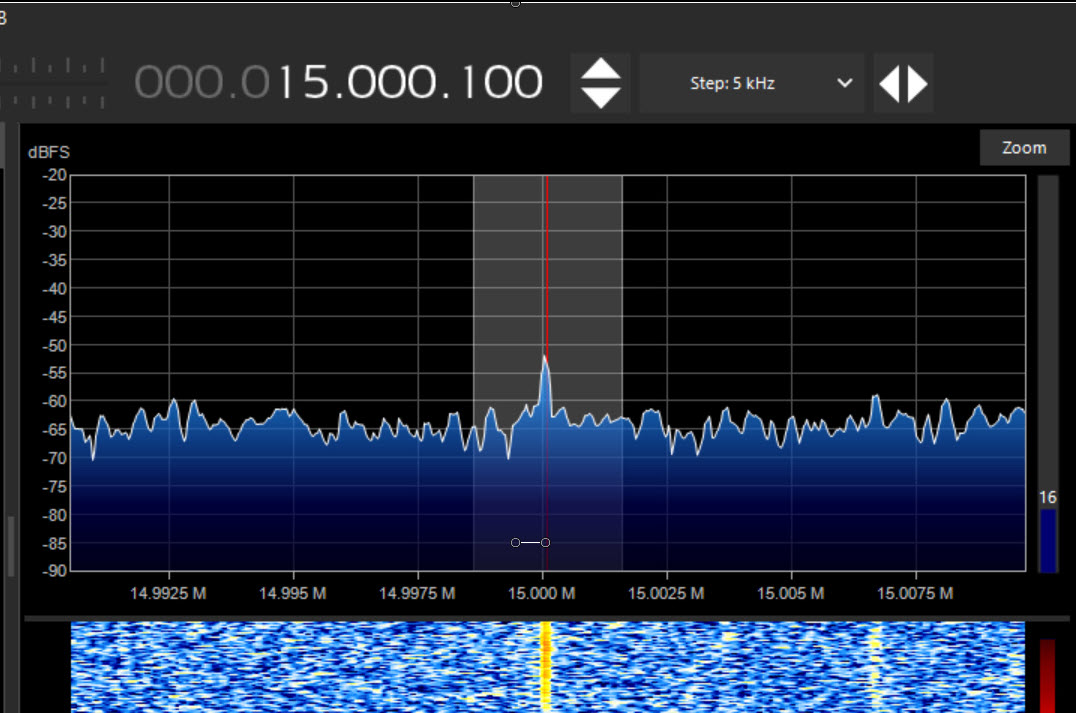


Figure 3 shows WWV reception at 2.5/5.0/10.0/15.0/20.0MHz. The carrier shown at 2.5MHz is not WWV but probably a harmonic/intermod of the RTL. There is no signal visible at 5.0/10.0MHz. A small carrier signal was seen at 15.0MHz and a clear signal at 20.0MHz. Figure 4 shows reception at 20MHz with the special propagation signal sent at 8min past each hour.
VOACAP


VOACAP is a powerful HF propagation program originally developed for the Voice of America (Ref.4). It can be used as stand alone or with an interactive web interface. Figure 5 shows the web interface for propagation analysis between WWV and my home QTH. Figure 6 is the resultant propagation wheel and Figure 7 is the Propagation chart.
| Band Meters/MHz | Prop Reliability % |
| 10m/30MHz | 0 |
| 12m/25MHz | 10 |
| 15m/20MHz | 60% |
| 17m/17.6MHz | 80% |
| 20m/15MHz | 70% |
| 30m/10MHz | 60% |
| 40m/7.5MHz | 30% |
| 60m/5.0MHz | 0% |
| 80m/3.75MHz | 0% |
Figure 8 shows the propagation reliability figures taken from the Prop Wheel in Figure 6. The RTL-SDR receive levels indicate a good signal at 20MHz, very weak signal at 15MHz and no signal anywhere eles. This corresponds to the propagation wheel results.
HF Radio Telecommunications Learn by Simulation
Please send your comments, questions and suggestions to:
contact:

References
#1. – “RTL-SDR for UTC Time in The Tropical Rainforest”
https://jeremyclark.ca/wp/nav/rtl-sdr-for-utc-time-in-the-tropical-rainforest/
#2. – “WWV Time Signals”,
https://www.nist.gov/pml/time-and-frequency-division/time-distribution/radio-station-wwv
#3. – “VOACAP – CHU to VE3PKC”
https://jeremyclark.ca/wp/telecom/voacap-chu-to-ve3pkc-2/
#4. – “VOACAP”,
https://www.voacap.com/
