Introduction
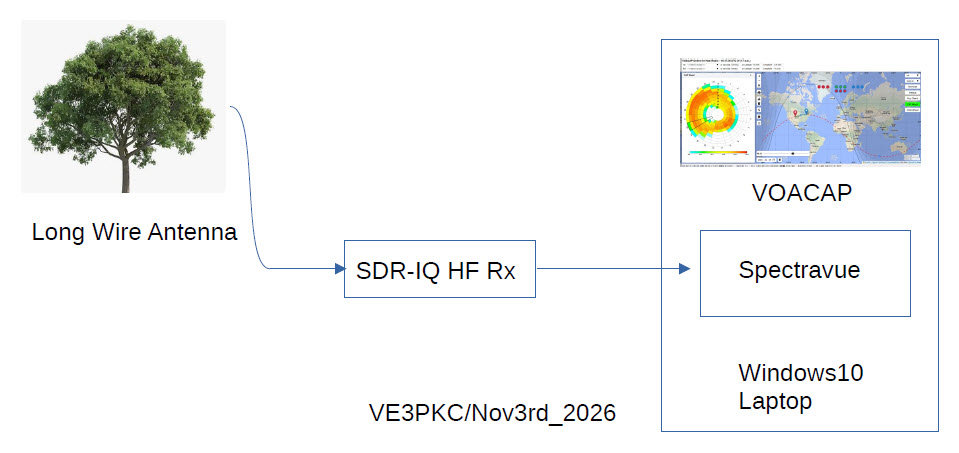
In previous videos I looked at HF propagation using WWV, CHU and NCDXF/IARU beacons (Refs.1/4). Recently the Canadian CHU time station was taken off the air. In this post I will look at receiving WWV using the SDR-IQ receiver and a 10m long wire as shown in Figure 1. WWV station frequencies are 2.5/5/10/15/20/25MHz. Transmit power is 10KW on all bands, except 2.5/20/25MHz where the power is 2.5KW. Antennas are 1/2 wave verticals mounted on a 1/2wave vertical towers. Transmission: AM_DSB , 50% Tones, 100% Secs, 75% Voice. Latitude = 40.68degN & Longitude = 105.04degW (Ref.5).
SDR-IQ Reception
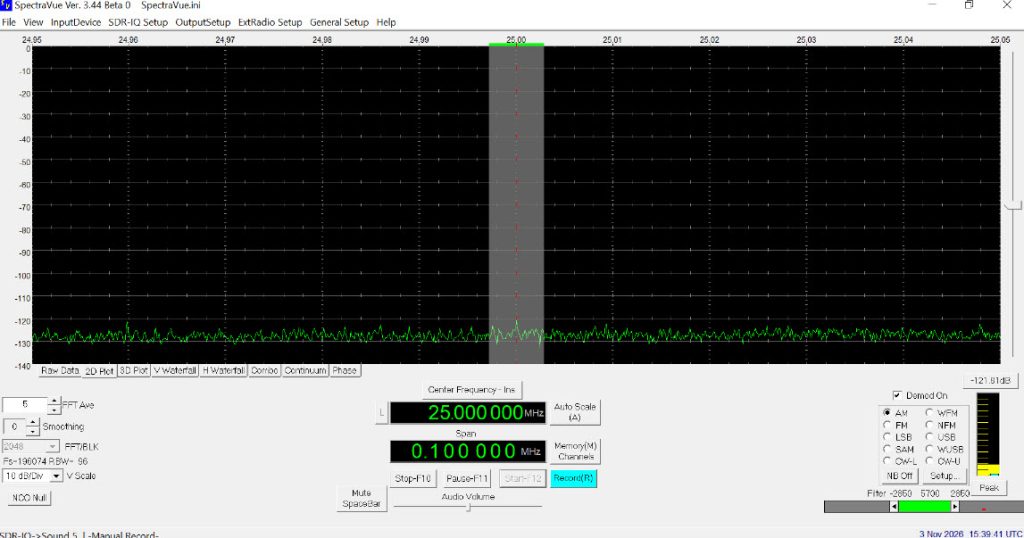
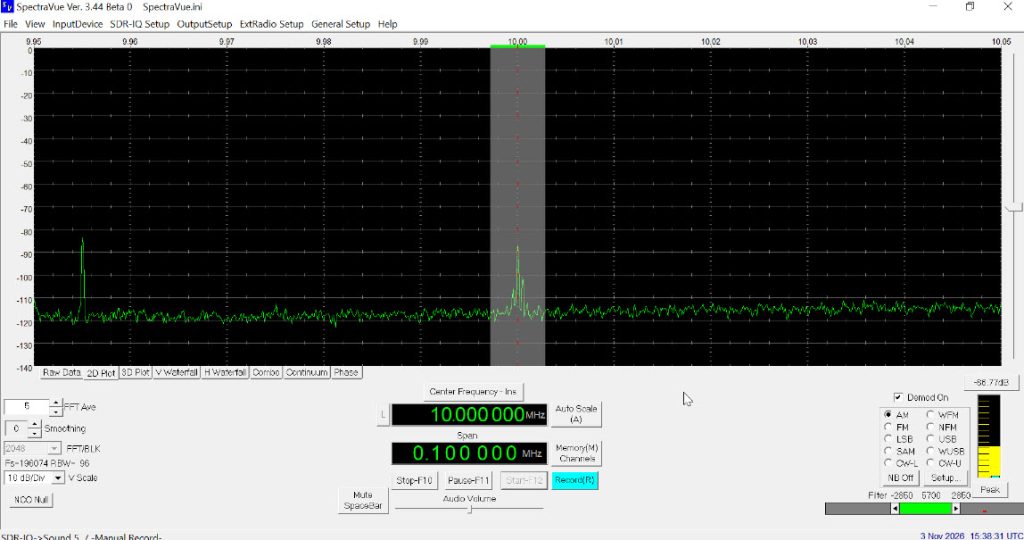
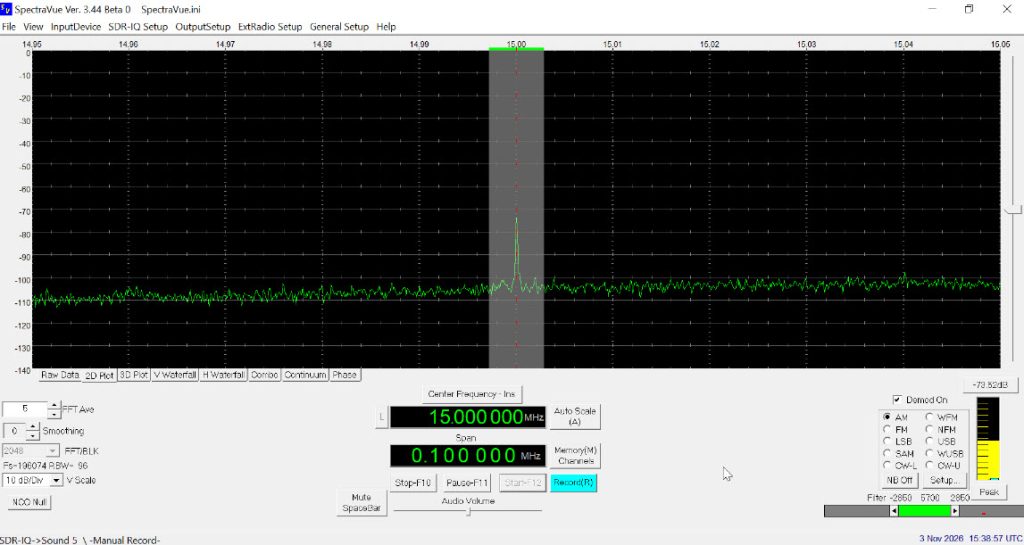
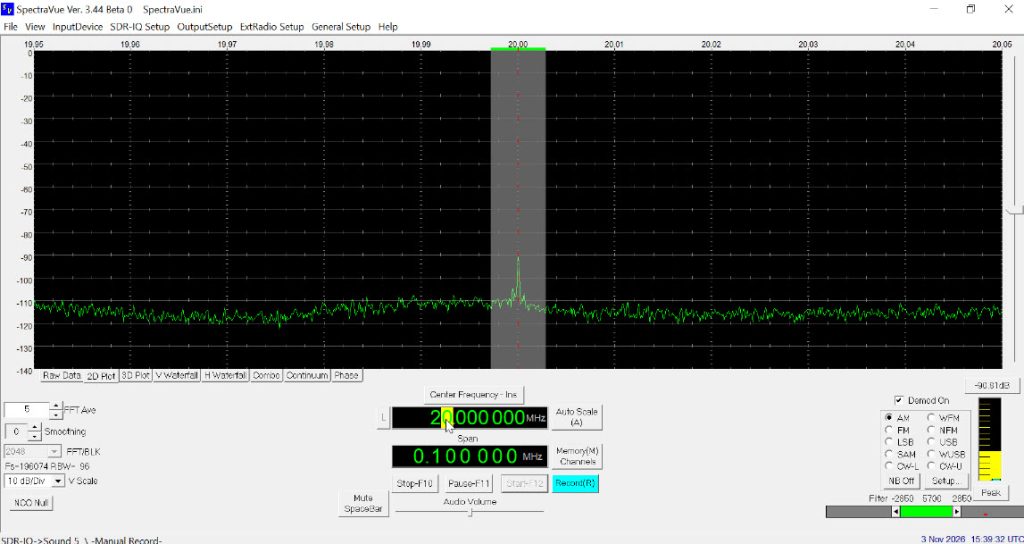
| Frequency | Tx Power | Rx/Noise Level dB | VOACAP 1430UTC |
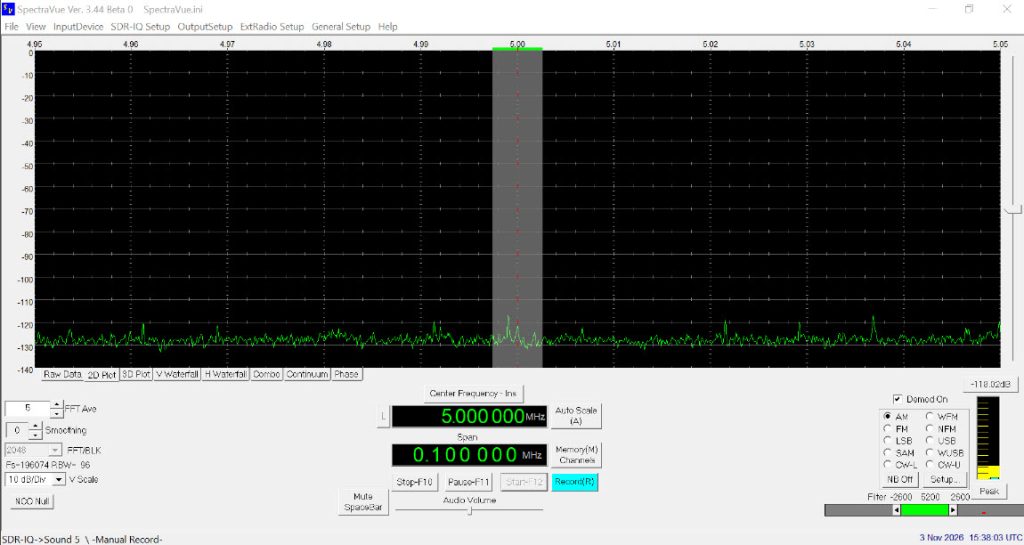
| 5.0MHz | 10KW | noise/-130 | 0% |
| 10.0MHz | 10KW | -85/-120 | 60% |
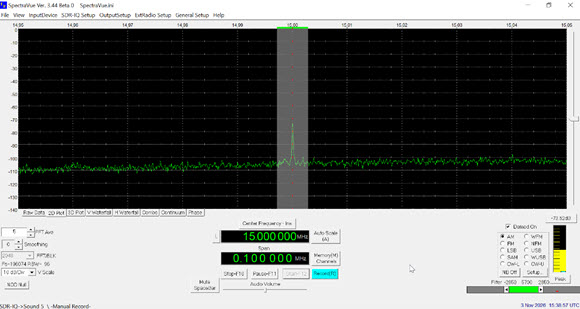
| 15.0MHz | 10KW | -75/-105 | 80% |
| 20.0MHz | 2.5KW | -90/-110 | 85% |
| 25.0MHz (Experimental) | 2.5KW | noise/-125 | 40% |
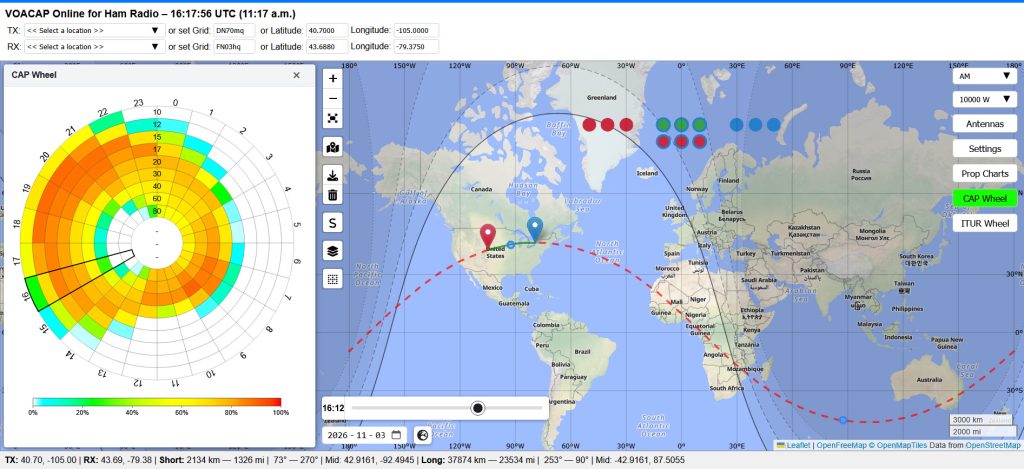
Figure 2 shows the VOACAP propagation wheel for transmission between WWV and Toronto Canada for Nov3rd_2026 at 11:17EDT/16:17UTC. Figures 3/4/5 show the received signal levels as captured on Spectravue. No signals were received on 5MHz & 25MHz, good signals on 15MHz & 20MHz and a weak signal on 10MHz. These levels correspond with the reliability figures given by VOACAP. You can see/hear the signals on the YouTube video.
Solar Cycle 25
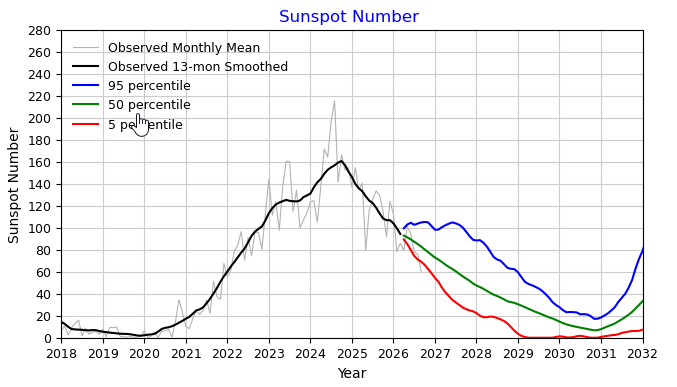
From Figure 7 you can see that we have passed the maximum of Solar Cycle 25 which peaked in 2025 (Ref.6).
HF Radio Telecommunications Learn by Simulation
Please send your comments, questions and suggestions to:
contact:

References
#1. – “RTL-SDR for HF WWV Propagation”
https://jeremyclark.ca/wp/telecom/rtl-sdr-for-hf-wwv-propagation/
#2. – “RTL-SDR for HF Beacons Propagation Prediction”
https://jeremyclark.ca/wp/telecom/rtl-sdr-for-hf-beacons-propagation-prediction/
#3. – “VOACAP – CHU to VE3PKC”
https://jeremyclark.ca/wp/telecom/voacap-chu-to-ve3pkc-2/
#4. – “VOACAP”,
https://www.voacap.com/
#5. – “Radio Station WWV”,
https://www.nist.gov/pml/time-and-frequency-division/time-distribution/radio-station-wwv
#6. – “NASA Solar Cycle Progression”
https://www.nasa.gov/solar-cycle-progression-and-forecast/
