Introduction
Back in October of 2020 during the Pandemic, I looked at FreeDV 1.4.1 an Amateur Radio digital voice program and compared it to standard HF SSB (Ref1). I used Scicos for the simulation of SSB & FreeDV with added noise. I found the FreeDV threshold at least 6dB better than just regular SSB. In the current November issue of ARRL QST, there is a fascinating article by David Rowe VK5DGR that describes the new version of FreeDV that uses machine learning applied to voice synthesis and compression (Ref.2). In this post I will repeat what I did before, but now with the new RADE version FreeDV 2.4.0 (Ref.3). I will use GNURadio this time, so that noise & channel parameters can be changed during run time.
SSB Simulation
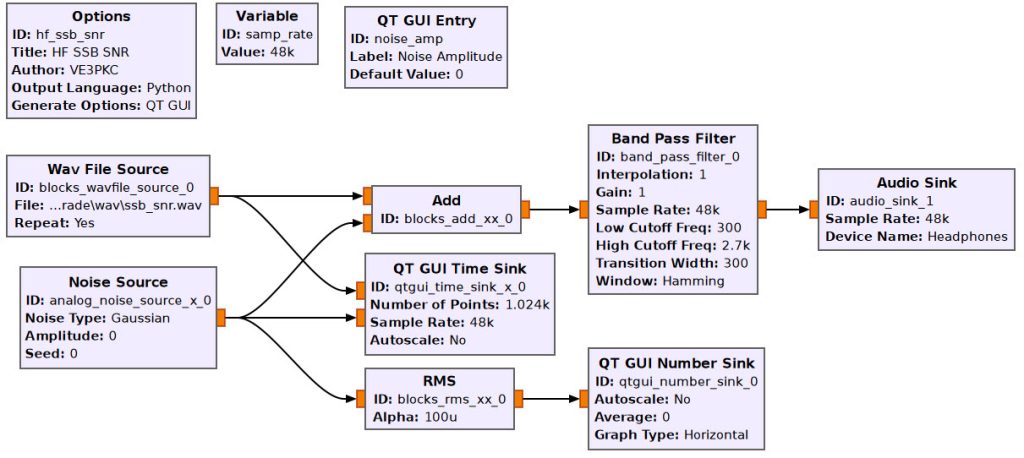
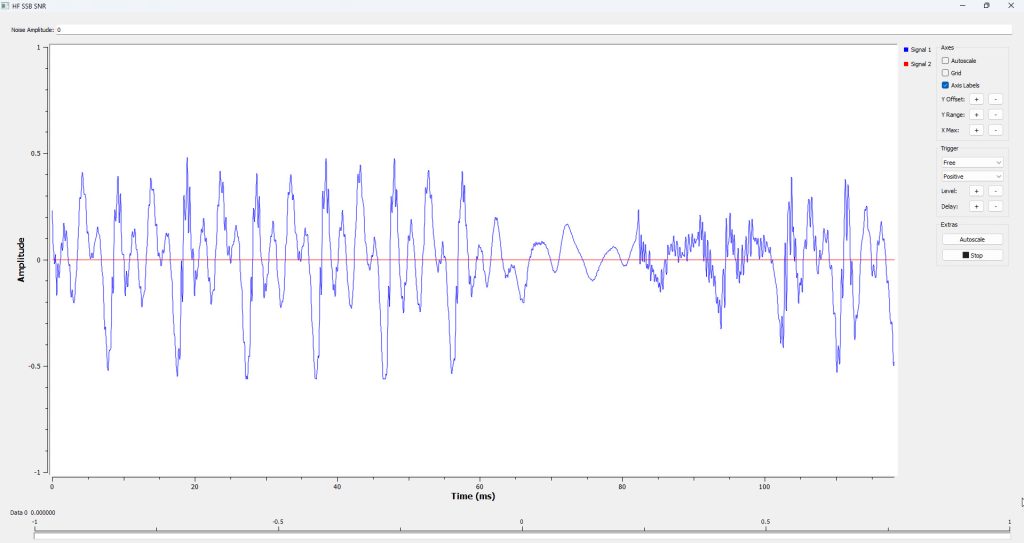
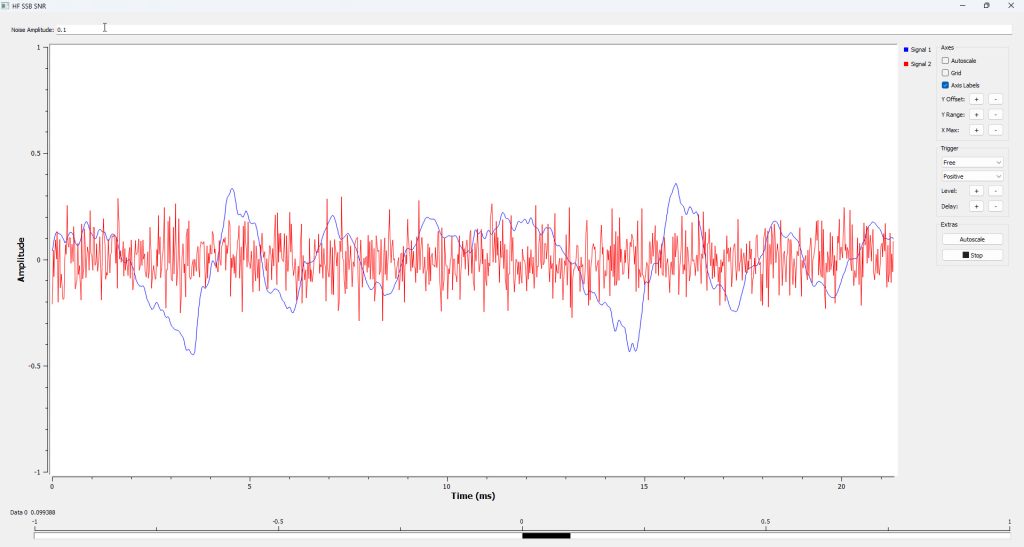
Figure 1 shows the GNURC block diagram used to evaluate the SSB SNR Signal to Noise Ratio. A 15 second voice wav file “snr_ssb_wav” is read into the schematic via a WAV File Source. Gaussian random noise is then added to this signal and band pass filtered at 300-2700Hz similar to an HF SSB bandwidth. The noise can be adjusted at run time by using a QT GUI entry block. The output then feeds the sound card for perceptual evaluation. An RMS block allows calculation of SNR. Figures 2 & 3 plot the voice signal vs. noise std dev of 0.0 & 0.1. Note these are baseband tests vs. RF carrier transmission.
| R Readability | Result |
| 5 | Perfectly Readable |
| 4 | Readable with practically no difficulty |
| 3 | Readable with considerable difficulty |
| 2 | Barely readable, occasional words distinguishable |
| 1 | Unreadable |
| Signal Voltage rms | Noise Voltage rms | SNR=20log (S/N)rms dB | Readability 1 to 5 |
| 0.7pk/1.414=0.5 | 0.1 | 14 | 5 |
| 0.5max | 0.2 | 8 | 4 |
| 0.5max | 0.3 | 4.4 | 3 |
| 0.5max | 0.5 | 0 | 2 |
| 0.5max | 0.7 | -3 | 1 |
FreeDV Rade Simulation
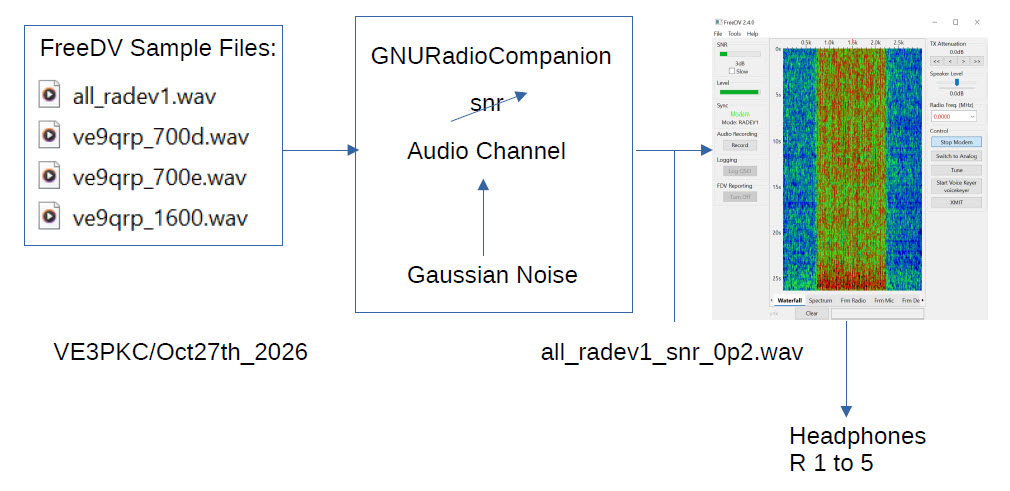
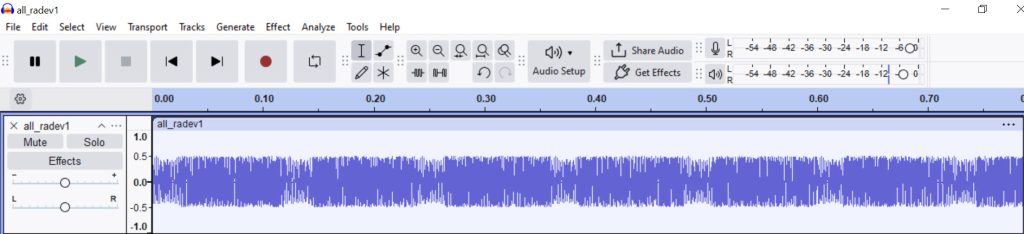
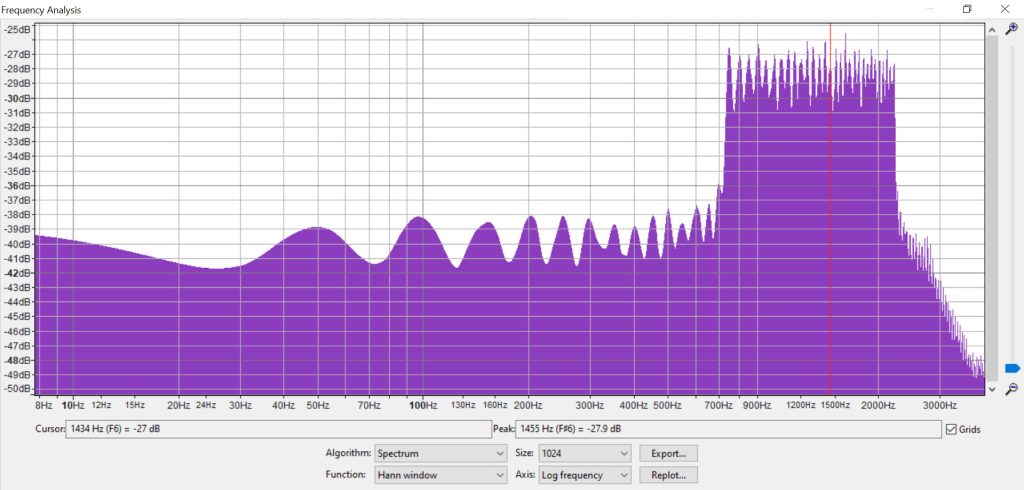
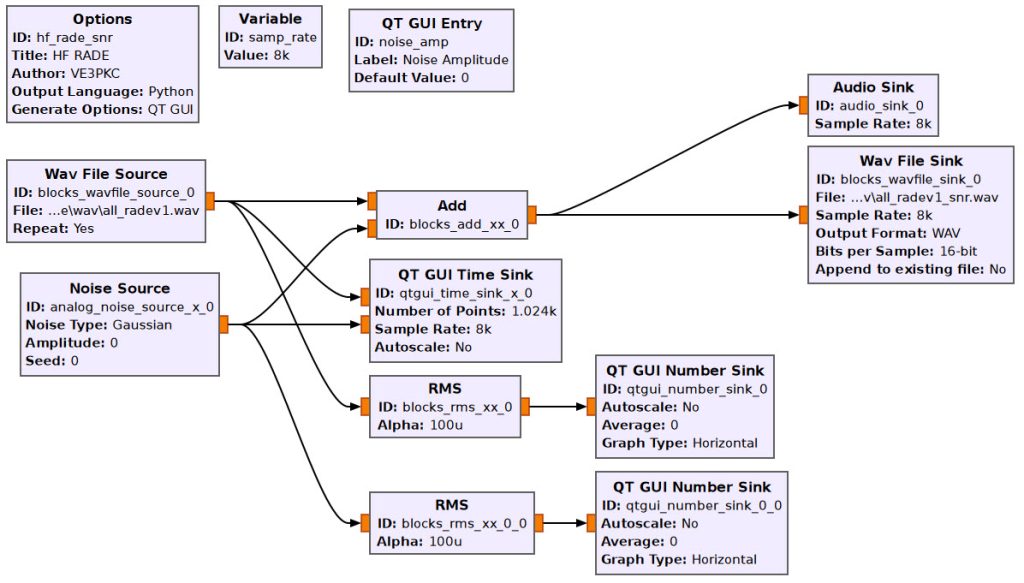
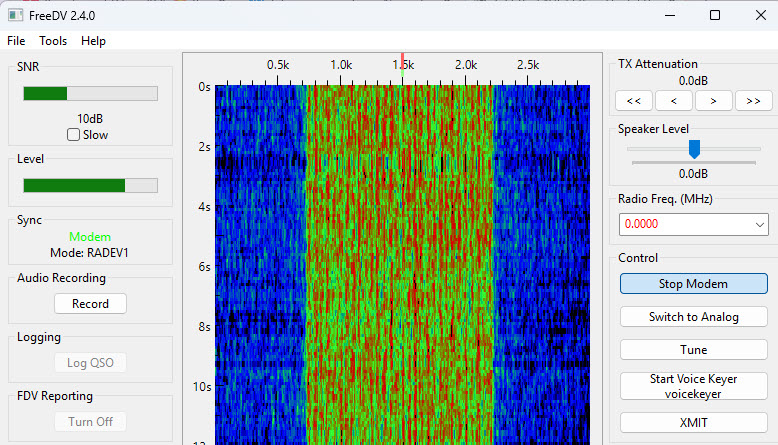
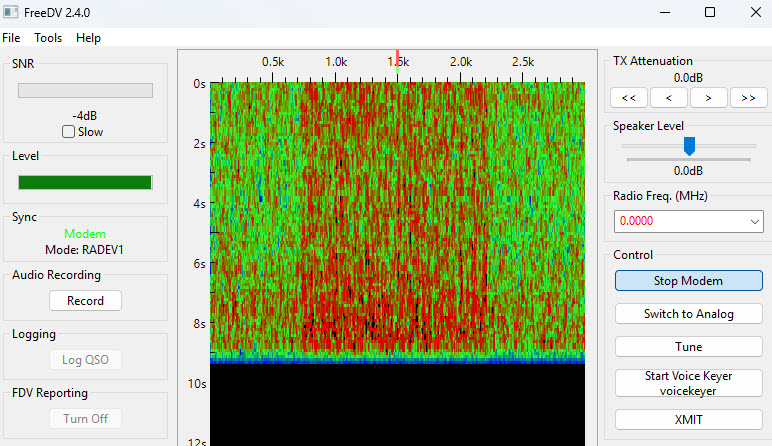
| Signal Voltage rms | Noise Voltage rms | SNR=20log (S/N)rms dB | Readability 1 to 5 |
| 0.32 | 0.1 | 10.1 | 5 |
| 0.32 | 0.2 | 4.1 | 5 |
| 0.32 | 0.3 | 0.6 | 4 |
| 0.32 | 0.4 | -4 | 2 |
Conclusion
Comparing the SSB and the all_radev1.wav file near threshold, the SSB is R2 @ snr = 0dB & the Rade is R4 @ snr = 0.6. For R5, the SSB requires about 14dB whereas the Rade only requires 4dB. These are big improvements considering on an HF channel every dB is important. Compared to my post in 2020, I notice that the Rade voice quality is much more natural.
HF Radio Telecommunications Learn by Simulation
Please send your comments, questions and suggestions to:
contact:

References
#1. – “HF SSB vs. Digital Voice”
https://jeremyclark.ca/wp/telecom/hf-ssb-vs-digital-voice/
#2. – “Radio Autoencoder (RADE)”, ARRL QST Magazine, November 2026
https://freedv.org/radio-autoencoder-rade-qst-november-2026/
#3. – “FreeDV Encoder”
https://freedv.org/radio-autoencoder
#4. – “RADE Introduction”
https://github.com/drowe67/radae/blob/main/doc/rade_intro_waveform.pdf
#5. – “RADE – Machine Learning for Speech over HF Radio (AREG March 2025 Presentation)”, YouTube Video
https://www.youtube.com/watch?v=LxjcAF7Vy0Y
#6. – “HF High Frequency Radio Learn by Simulation”
https://www.clarktelecommunications.com/simulation.htm
