
Introduction
In the last four posts I have discussed receiving CubeSats under various conditions and locations. In Montreal I discovered a perfect receive location with no QRM, but unfortunately the VEE dipole did not have enough gain to get a proper decode. The signal was visible but not decode-able. So my method now is to use my ATSC/UHF antenna and point it approx East/South-East and wait for a satellite path North-South or South-North that is entirely to the east with a slant range of <= 1000Km. My home QTH is surrounded by massive steel condos, not to mention a concrete balcony filled with magnetic absorbing iron rebar.
Reception Parameters
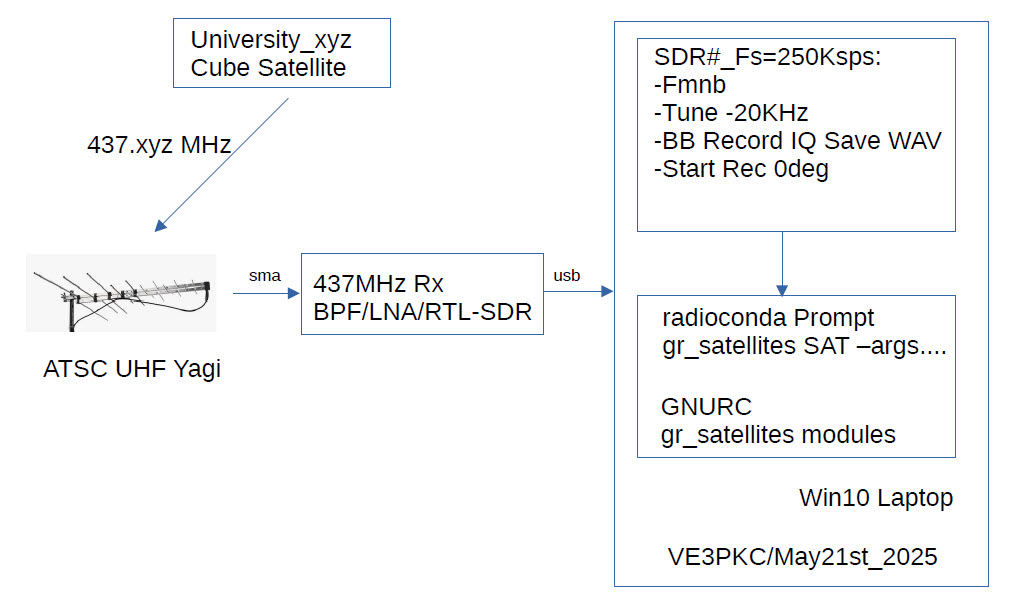
Figure 1 shows the equipment setup. The UHF Yagi is pointed due East. The 433MHz BPF/LNA/RTL-SDR is connected to the Yagi with a sma to catv adapter. A long usb cable then feeds a laptop indoors. SDR# is used and the sampling rate is set at 250Ksps to keep file size down. The frequency is set 20KHz below the satellite frequency. The reason for this is to allow for Doppler shift. On playback, you can measure the actual packet receive frequency then set this in the GNURadio Frequency Translation Filter. The Baseband IQ recorder is used and I start recording the minute my QTH appears in the satellite footprint. The satellite pass is typically about 5-8 minutes so the files get big. You can trim them later in Audacity. I keep the gain low at 19.7dB, but this depends on the active QRM, so I adjust this for minimum intermod.
Signal Capture


| Date | Relative Time | Frequency | SNR |
| May20 | 02:08.9 | 437.1082MHz | 5dB |
| May20 | 03:11.3 | 437.1048MHz | 15dB |
| May20 | 04:08.7 | 437.0976MHz | 20+dB |
Yesterday May 20 at approx. 11:46 EIRSAT-1 made a close pass to the East. This is the CubeSat that I received previously. Figure 2 shows the QRM that is present in the vicinity of the signal Rx freq of 437.1MHz. Figure 3 shows a decode-able pulse that was received when the satellite passed almost due East. The 5 discrete tones were 20dB+ above the noise floor and the Gaussian data was about 10dB+. The Rx frequency due to Doppler shift was 437.0976MHz. So in GNURadio the Frequency Xlating Filter is set to 17.6KHz (437.0976MHz – 437.080MHz).
GNURadio Decode


Figure 5 shows the GNURadio schematic used to decode the received packet. It uses the gr_satellites module Satellite Decoder as discussed in Ref.2. EA4GPZ has several excellent tutorials on creating decoders in GNURadio using the OOT module gr_satellites.
GNU Radio Companion Basics Course
Please send your comments, questions and suggestions to:
contact:

References
#1. – “CubeSat 437MHz à Montréal”
https://jeremyclark.ca/wp/telecom/cubesat-437mhz-a-montreal/
#2. – “RTL-SDR for 433MHz/70cm CubeSats Signal Captures”
https://jeremyclark.ca/wp/telecom/rtl-sdr-for-433mhz-70cm-cubesats-signal-captures/
#3. – “RTL-SDR for 433MHz/70cm Cubesats on GNURadio”
https://jeremyclark.ca/wp/telecom/rtl-sdr-for-433mhz-70cm-cubesats-on-gnuradio/
#4. – “RTL-SDR for 433MHz/70cm Cubesats”
https://jeremyclark.ca/wp/telecom/rtl-sdr-for-433mhz-70cm-cubesats/
